Dew Point, Humidity, Temperature: What do they all mean?
It’s hot, but what’s the difference between humidity and dew point and how are they connected? There’s a lot of numbers to keep track of and it can be confusing. Going out for a run at 80°F one day can feel very different to another 80°F day. Some days, the conditions can be so bad it can add more risk to your run. By better understanding temperature, humidity, and dew point, we can be safer on our runs and hopefully have more success in our training!
Humidity
Humidity: How much moisture is in the air compared to what it could hold. It changes with temperature—warmer air can hold more moisture. 100% humidity means the air is completely saturated and cannot hold more water vapor.
Humidity tells you how “full” the air is with moisture.
Source: National Oceanic and Atmospheric Administration
Dew point
Dew Point: The temperature at which the air becomes so full of moisture that it starts to condense (like dew on grass in the morning)— in other words, the temperature at which humidity would hit 100%.
Dew point tells you how “sticky” it feels. The higher the dew point, the muggier it feels.
Which metric should I pay closest attention to?
Dew point is a key metric we often look at during the summer, as it directly measures how humid and uncomfortable the air feels.
Below 60°F: Comfortable. You’re good to exercise as normal.
60-64°F: It’s not great, but it’s manageable with some minor adjustments
Dew point 65–69°F: It’s going to feel tough and adjustments to your training are recommended
70-74°F: It’s going to be a swampy one. Consider taking it easy or switching to indoor activities.
75°F+: Drowning in your own sweat. Pure misery awaits you!
How to adjust your training
Now we have a better understanding of temperature, humidity and dew point and how it impacts our performance, what do we do with this information? How should I adjust my training? We know some days will be tougher than others, but training in the heat can have significant physiological benefits that can improve our fitness so we don’t want to miss out on these. We also don’t want to overdo it, so how do we adjust?
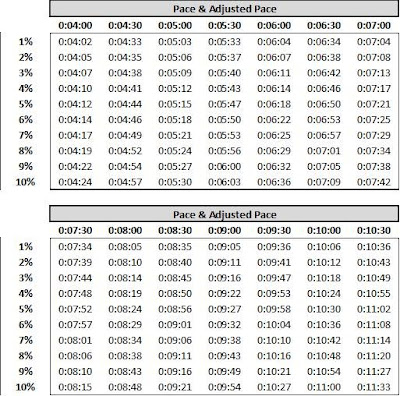
One way is to adjust your pace for each run. Here are two charts from Maximum Performance Running that may be helpful when discerning heat, humidity, and dew point on your training:
Temp + Dew Point Pace Adjustment Chart
Source: Maximum Performance Running
Adjusted Pace Chart
Source: Maximum Performance Running
Add together air temperature and dew point and see where the combined number places you on the following adjustment chart:
100 or less: no pace adjustment
101 to 110: 0% to 0.5% pace adjustment
111 to 120: 0.5% to 1.0% pace adjustment
121 to 130: 1.0% to 2.0% pace adjustment
131 to 140: 2.0% to 3.0% pace adjustment
141 to 150: 3.0% to 4.5% pace adjustment
151 to 160: 4.5% to 6.0% pace adjustment
161 to 170: 6.0% to 8.0% pace adjustment
171 to 180: 8.0% to 10.0% pace adjustment
Above 180: hard running not recommended
For example, on the day I am writing this, it is 80°F, 62% humidity, and 66° F dew point, giving us a total of around 145. Since I would normally do my easy run around 8min pace, I would adjust that 3-5.4% and run about 8:14-8:19 pace. Likewise, another athlete may adjust their 6min pace intervals to 6:11-6:14 pace. Avoid chasing numbers early on and allow yourself to adapt to the new season.
Note: these numbers are a guide to adjusting your training, it is still important to listen to your body and adjust based on how you are feeling. You may need to run slower than the percentage changes recommended here.
So next time before you go out for a run or plan your daily activities and check that weather app, you now have a better idea of what the conditions you will be running in and hopefully be better prepared to adjust to perform. In summary, always be mindful of the weather, especially the dew point, listen to your body’s signals, and adapt your plans as needed to ensure a safe and effective run. As they say, heat is the poor man’s altitude, so let’s be grateful for this free training camp!