
Are We Over relying On Pace? An Alternative Approach
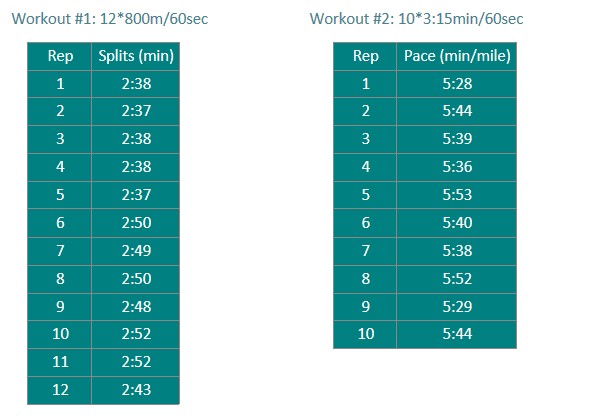
I’ve bombed a few workouts lately. It hasn’t been pretty. I normally pride myself on executing a workout with control to help, but these were not it. These were reckless. Look at that first workout of 12*800m/60s. It’s a juicy workout, but I’ve done this workout many a time. I know it well and have executed it well in the past hitting “the right” pace, but not this time.
Based on previous versions of this workout and where I felt I was in my training I felt ~2:40min was a reasonable guideline for each rep. I started out so good and then slowly but surely the splits start to slip away from me. The 2nd Half me is a shadow of the 1st half. There’s a 15sec difference between my fastest and slowest split. That can’t be good. I was too ill-disciplined early on and paid for it on the back half when I just couldn’t get close to my target times. I rally on the final one just to show I’m not a complete failure, that I still have some fight left in me, but I’m just kidding myself.
Then a few weeks later you’d think I had learnt my lesson , right? Wrong! Another classic workout and very similar to the first workout, but this time 10*3:15min/60s aiming for ~5:35min. I’m all over the place this time, I just can’t find my rhythm. One rep I’m smooth sailing at 5:36 the next I’m completely off track at 5:53. What is wrong with me? I wrap up the cool down and trudge home to sulk while conjuring up all the pent up frustration I’m about the unleash on my (imaginary) coach. I’m disappointed in myself and I’m sure my coach is going to be disappointed in me too (Newsflash, he’s not because he’s never disappointed when I’ve tried).
What’s strange is, in both these workouts I didn’t feel bad. In fact I felt surprisingly good in them. In workout #1 I never felt like I was fading or dying, in fact I felt like I was growing into the workout. I finished it feeling like I could probably do a couple more reps although the thought of actually doing that wasn’t totally appealing at that point. The same goes for workout #2. Sure it was tough, but all the reps felt the same level of exertion to me and I had even considered adding on another rep but opted to not get greedy and wrap it up while the going was good and think about future me.
The thing is, I haven’t been completely truthful with you. I left out some important details. Take a look at the workouts again, but with additional data included (power).
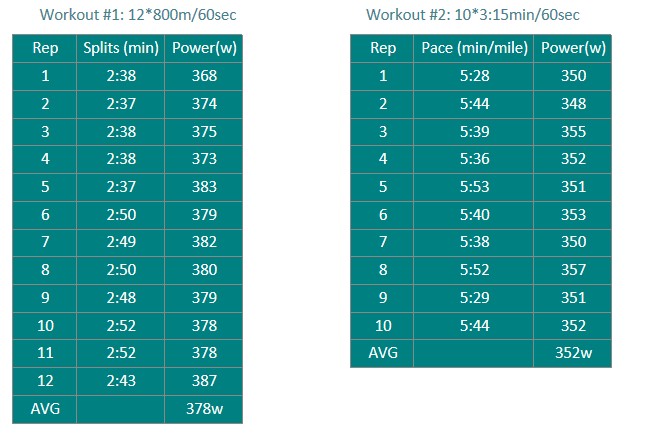
You see Workout #1 (12*800m) was done on a long stretch of uninterrupted road on the coast of the River Mersey. The first 5 reps had a beautiful tailwind pushing me on. The next 6 reps were in reverse were not so kind, heading into same that wind with gusts up to 20mph (and the final rep was me ducking out into a side road). The route back was not so much fun. Trying to hit the same splits on the way back would have been fruitless and defeated the purpose of the workout. There’s a similar story to Workout #2. No wind this time, but a very rolling neighborhood loop. Some reps fell very kindly on the majority downhill, while others hit just right for a grueling uphill test. Staying on pace for each rep just wasn’t a realistic expectation
On review, I actually CRUSHED these workouts. These weren’t perfect by any means, but they were executed to a high standard and I’m confident I met the intended purpose of these workouts. How can I be so sure? Two reasons:
Feeling Good
I felt it. I felt good during them. I felt in control. These were both Threshold sessions and usually a decent marker of how we feel during a Threshold session is that we could still do 1-2more reps without having to significantly increase exertion levels while maintaining the same level of performance. This matched how I felt. I listen to my body a lot during workouts and races, and I have a good understanding of how my body should feel for different intensities. I never felt I was significantly adjusting my exertion levels during the workouts, some sucked more than others (that wind 😮💨), but they all felt similar in the moment. This is a great starting point.
Power Numbers
My power numbers. My what? Things are about to get a little nerdy, but I’ll try to keep it as simple as possible. For the past 18months I’ve run with a Stryd Pod which is a power meter that is attached to my shoe (you may have noticed that little black thing). Think of it as a sensor that measures how hard you’re running, not just how fast you’re going. Cyclists have used power meters for years, but it’s beginning to creep into running too. It measure running power in watts in real time while taking into consideration gradient and wind. Basically, how much effort I am exerting with each step. Check out both workouts with the power numbers this time.
Pace Vs Power Vs Effort
When looking at Workout #1, my average power for each rep was 378watts. 10 of the 12 reps were within 5w of that average. That’s impressive and shows that despite the perception that I faded on the back half of the workout, I actually maintained an almost identical level of effort throughout. With the wind behind me, or wind coming at me, I was working at a very similar level in each scenario even though my pace suggested otherwise. The 2 outlier reps were the first one which was 10w lower as I eased into the workout (recommended) and the last one which was 9w higher as I pushed it a little to finish off (how naughty of me🤪). The fact that the rep with the lowest power output (rep #1) was one of my fastest reps (2:38min) tells me just how strong that tailwind was in that rep (I was running my fastest rep while applying the least amount of effort thanks to the wind pushing me along).
Looking at Workout #2, it’s a similar story. My average power for each rep was 352watts. All reps are within 5w of that average. It’s difficult to get much more consistent than that. I was working equally as hard on each rep despite the paces suggesting otherwise. What’s also worth noting in this workout is that rep #8 was the rep in which I exerted the most effort, but it was also my slowest rep thanks to that rep mostly taking place on the hilly section of the loop. Looking at pace alone here would suggest I was fading and struggling on this rep when in fact I was at my strongest. Suddenly that post workout cool down is no longer a trudge and is more of a skip and beaming with confidence (funny how the narrative we tell ourselves can do that).
Training Application using Pace, effort, heart rate, and power
No, it’s not to go out and buy a Stryd Pod. Although useful, there are several limitations with this device (and strict testing protocols) which I won’t be covering here because I’ve already gone on long enough (I plan to cover more about training by or with power in the future though). Your watch may say it records power, but it is not an appropriate measuring device to be used due to it being inaccurate (a guess at best) so please don’t use that. The takeaway is also not to totally ignore pace either. Instead, it’s to encourage each of us to be less reliant on pace as a metric of performance. The pace on our watches only tells part of the story and sometimes it’s more the red herring than the smoking gun we think it is. There’s no single measuring metric that rules them all, instead each one helps to piece the puzzle together. This is why you may see different metrics such as RPE, pace, or Heart rate included in a workout to help guide you (even though you only have eyes for that pace 👀).
On those days where the weather conditions are not ideal or the route is more rolling than flat conditions (conditions which I encourage you to seek out for your workouts because they are more likely to simulate your race day experience), here’s how I approach my workouts (and races):
During a run, I start with perceived exertion; What is the intention of my run and how should that feel? How do I feel right now and is it aligned with how it should feel? I adjust my exertion levels based on those answers. Although not perfect, with years of experience and intentionally focusing on ‘how my body feels’ at different intensities I’ve become very adept at knowing how different intensities should feel. It’s a difficult skill to master, but I’ve worked hard at it (and one of the reasons I discourage using pre-programmed workouts with pre-set paces).
Next I’ll then typically look at my power reading. I’ve collected enough data on myself that I know what my power zones are (like heart rate zones) for different intensities so I go into a workout having a rough idea (not completely set in stone) of what my power numbers might be. The first 5-10min of a workout or 1-2 reps is where I try to balance out my perceived exertion and my power numbers before I get locked into my rhythm for the rest of the workout hopefully. If I’m slightly below or above my power ranges I may try to increase or decrease my exertion slightly and see if it still “feels” right. It’s a fun game of finding that right balancing act and can help pass the time on a workout. I’m not religiously checking my power number constantly though, more just a cheeky glance every couple of minutes in the first few reps and then maybe once each rep thereafter once I’ve settled into my groove.
If my Power meter is down (it has limitations), I’ll do something similar with my heart rate which I take from my Coros armband which I wear 99% of the time. Again, I know my numbers and have a good estimate of where I should be for different intensities. Heart rate also has limitations (impacted by sleep, medication, diet, time of day, stress etc.) so I’m not 100% relying on it, but I can use it in collaboration with my perceived exertion.
If you don’t own a power meter or use a reliable heart rate monitor (i.e. a chest strap or armband that you wear 99%+ of the time), then I would encourage you to lean more into how a workout and each rep ‘feels’ and move further away from relying on pace when working out, especially in those less than perfect conditions. Work on fine tuning your internal body cues. Does the level of exertion feel right for this workout? Does the level of exertion feel similar to the other reps
There’s more to cover on this topic, but we’ll save that for another day. I hope this at least gives you food for thought and you begin to view and interpret your workouts differently, especially when not done in perfect conditions.