
Racing With Purpose: How to Approach Your Goal and Tune up Races
Why it’s important to think about your race approach
Although we’d all love to pull out a Personal Record (PR) each time we race, the reality is that this doesn’t happen, and for good reason. If we treated every race the same way we’d end up either under recovered, under trained, peaking too early, or flat for when it does actually matter. A smart approach to training is to specifically target a goal race and plan our training to specifically meet the needs of that race (specificity) as well as aiming for our fitness to ‘peak’ at the time of that goal race. Other races along the way, which we refer to as B or C races (or tune up races) serve the training for our A goal. These “tune up” races serve an important purpose which we will discuss below, however it’s important to understand how we prepare and approach these races will be very different to how we approach our goal race. Essentially we are placing our races in a hierarchy order from most important (A Race) to least important (C Races). Training load (volume and intensity), workout focus, density of workouts, auxiliary work (i.e. strength), nutrition will look very different for each level of race preparation. It’s important that these B & C races do not become distractions that disrupt training, but instead support it.
It’s very possible you have in fact PR’d (or will) during a tune up race. Often that’s a good sign your training is helping you get fitter. We’ve coached many athletes who will PR a shorter race distance along the way to a longer race distance which can serve as a great confidence boost. However, when we work with athletes, this is not our specific intent, but can happen as part of the process of working towards our main goal. This is especially common in beginner athletes due to their minimal exposure to racing. Sometimes, especially if we underperform in our goal race, it can be a negative to PR in a tune up race because we have peaked too soon or have developed an aspect of fitness that was not specific to our goal race (i.e. 5k Vs. Marathon). You may not know that until it comes down to your goal race.
When I work with athletes, I collaborate with them to map out their training over a specific timeline. I identify a specific goal race that is an appropriate amount of time away, and map out additional tune up races that will support their training in terms of timing, distance, and preparation for our goal race. A common mistake I see in runners is adding races to their calendar without assessing if they will support their goal race and their training. Sometimes that means stepping away from the popular local race, or one your friends are doing, but that’s a sacrifice I may recommend if it helps us reach our goals. On the flip side, some runners prefer to not run any tune up races on their calendar and instead focus solely on their goal race. For most athletes, I don’t recommend this approach as I believe there are many benefits to racing during a training block that can prepare us for our goal race day. Hopefully better understanding how and when we can run tune up races will help us have a more successful training block with a positive outcome on our goal race day.
The 'A' Race: Your Goal Race
This is the race we have been specifically training for, typically over 10-18weeks (sometimes longer). We will go full send with a maximal effort in this race. The race is followed by a recovery period as you wrap up your training block.
The aim is to come into this race feeling sharp and fresh. Workouts in the weeks leading up to this race will be very specific to the demands and conditions of the goal race. If we are preparing for a hilly marathon then we can expect to see workouts close to our marathon pace on hilly routes.
There is a full taper which the length of will depend on the race you are preparing for (see table near the end of this article). During that taper, training volume will be reduced, workouts remain specific to the race, but will be dramatically reduced in volume (i.e. instead of 7*800m, you may do 3*800m).
If preparing for a race longer than 1 hour, there may be a full carbo loading process put in place.
The 'B' Race: Your Tune-Up Races
Depending on the distance you are training for and your background as an athlete, there may be more than one ‘B race’ on your training calendar. The purpose of B races are to prepare you for your goal race. As such, our lead up to these races and how we approach them will be different to our A race.
Our aim is not to peak for these races (hence why the intent is not a PR), it is to serve the training for the bigger goal. We can still opt to race these as a full effort as a way to assess our fitness, but the structures before and after this race remain in place for a typical B race as stated below. It is the training structure around the race that can make it a B race if we choose to race it at full effort.
How Training Changes Around a 'B' Race
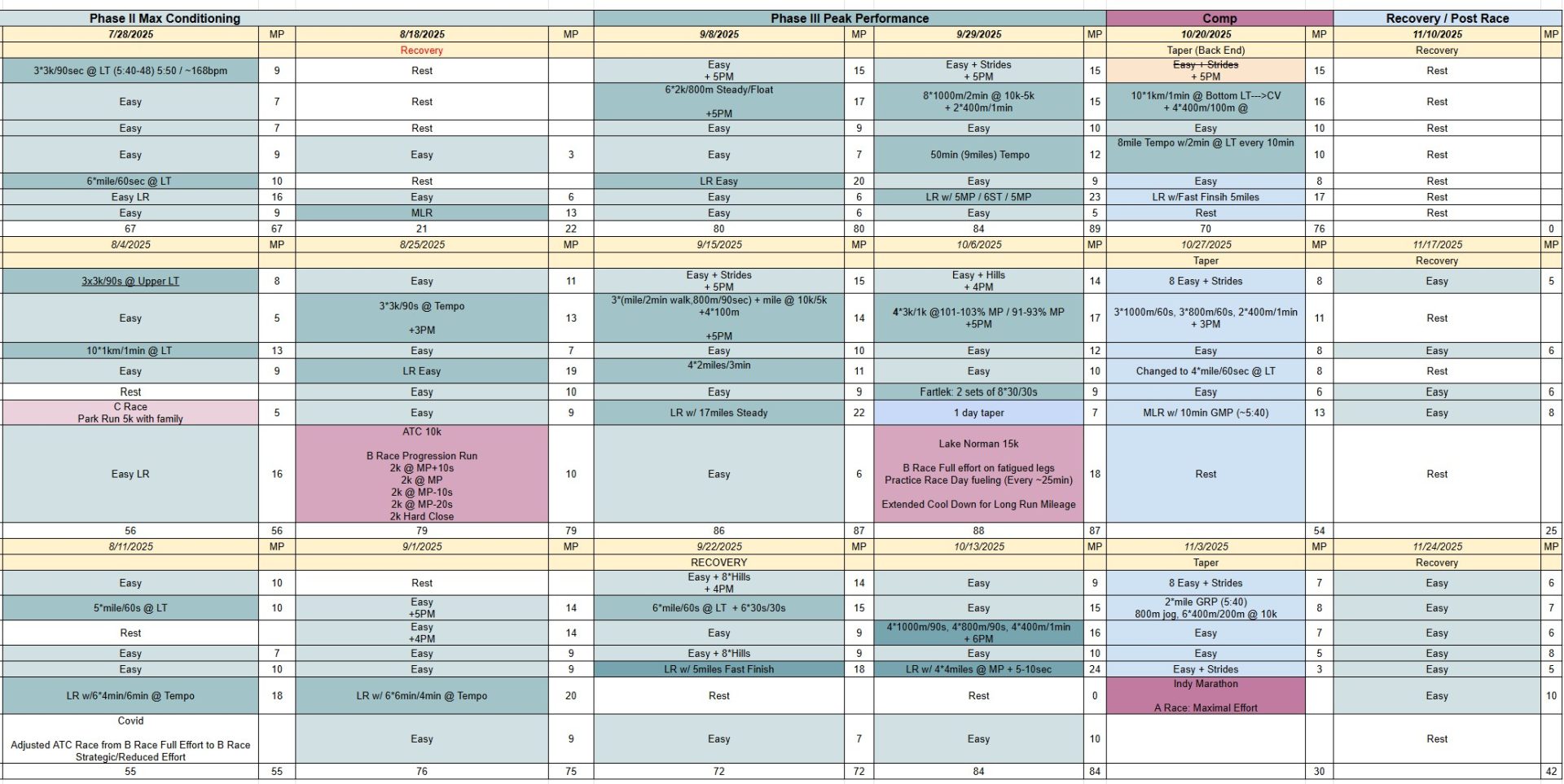
For B races we may have a very minimal taper (perhaps 1-4 days depending on the race distance and intent of the B race). We don’t want our core training for our main goal to be interrupted so keeping a similar flow to our week to maintain consistency is important. This means we’ll be carrying some fatigue into the B race which will impact performance (which can be a good thing as mentioned below). We do not want to be adding in additional rest days or dramatically reducing volume or intensity in the build up to a B race.
The type of workouts you are doing around the time of a B race may not be specific to that B race. Although you may be running a flat 5k this weekend, your workouts in the weeks before this B race should be preparing you for your goal race. Typically I recommend not cutting back on volume or intensity for that workout 4 days or so beforehand, but if you do, keep the intensity, but cut back the volume of it no more than 15%.
In comparison to an A race which has a distinct extended recovery period following the race, the post B race training should look fairly similar to a normal training week. How you approach this varies from runner-to-runner and how the B race was executed. If we’ve gone for a hard effort then we may build in a short 1-5 day recovery window following the race, perhaps pushing the next workout back 1-4 days, but ideally the rhythm of our training for our goal race is not overly disrupted here. For those runners that end up treating their B race like an A race, the post B race recovery is the biggest consequence that can negatively impact their training for their goal race. This is why I often recommend for most runners (not all) not racing a Half Marathon hard as a tune up race for a marathon as the recovery cost is high and takes away from the core goal race training.
What a 'B' Race Can Do For You
B races can serve multiple purposes, but it’s important to be intentional and narrow your focus rather than trying to accomplish everything in one race. Decide which purposes will best help you work towards achieving your main goals, and approach the race with those in mind. Here are several ways that a B race may serve our training.
Physiological Sharpening – This is the one that matters most and can’t be replicated in training. When you race, you access a level of neuromuscular recruitment, central nervous system output, and autonomic arousal (the adrenaline, the elevated heart rate, the cortisol) that simply doesn’t exist in a solo workout on a Tuesday morning. The competitive environment, the willingness to push deeper into discomfort when someone is on your shoulder, all of that drives the body to recruit high-threshold motor units and sustain that recruitment in a way training alone can’t match. This is why athletes often run their second or third race of a season better than the first, even when fitness hasn’t meaningfully changed. A B race gives your body and brain live exposure to this higher level, so it’s more accessible when it counts on goal race day.
Fitness Check – A well-timed B race gives us objective data on where your fitness is, not a workout estimate or a theoretical prediction, but an actual race performance under real conditions. This may guide workout intensities, confirm that fitness is progressing, and help assess realistic expectations for goal race day. It can be a confidence boost, or it may be an opportunity to recalibrate.
Race Day Mentality – This is a huge reason why I encourage athletes to include tune up races in their training block. It’s not easy to just turn it on for our goal race day. We may be physically prepared but are we mentally prepared? Can we get ourselves excited or pumped up for the race? If we are going for a hard effort here, it’s a good way to see how we handle ourselves when the going gets tough. Can we sharpen that mental edge to push through the discomfort? Can we work on converting those negative thoughts into positive, more constructive ones in those tough moments? Race day can also be a mix of anxiety and/or excitement, and we need to be able to recognize situations that can trigger an emotional response, understand how we typically respond to those triggers, and then asses if we need to adjust that response. How do we respond to the pressure of the race if there’s a goal time (not necessarily a PR) or finishing position being targeted? How do we handle the adrenaline and excitement of the crowd pre-race and early on in the race? How do we manage our sleep and performance in the buildup days leading into the race? These are all things we can gain exposure to and refine without the pressure of it being a peak race.
Racing Under Fatigue – Since we are not carrying a full taper into the tune up races we will be carrying fatigue into them. This can help simulate the later stages of your goal race right from the early part of your B race. What a great way to practice that goal race pace to see if it’s manageable when your legs aren’t completely fresh! This is one of the strongest arguments for why B races shouldn’t be tapered for: the fatigue itself is part of the training stimulus.
Race Day Strategy – Are we planning on running even splits, negative splits, positive splits, 5km progressions, or some other format on our goal race day? Are we going to practice running our goal 5k pace for the first 3km of the race to see how it feels and then back off for the final 2km of this 5k race? Will we be trying out mid races surges to break away from the pack to see if our body is strong enough to handle that? This is the perfect time to practice that race day strategy so it’s not foreign on race day. Being disciplined to a race day plan is an essential skill for executing well on race day and it must be practiced for that skill to be developed. If you are ill-disciplined during your tune up races, that will likely transfer to your goal race (and training) too. Make a plan, stick to it, and assess how it went.
Practice Race Conditions
Weather – We never know what conditions we’ll get on our goal race day so a tune up race gives us another data point for a specific set of conditions. If your B race is on a very hot and humid day, it gives us a realistic expectation of how to approach our goal race if that also happens to have hot and humid conditions. Same goes for a windy tune up race that is matched on your goal race day. Pouring with ice cold rain at the start line, well now you have a better idea of what attire to wear and how that impacts your performance. Use this as an opportunity to better understand how different conditions impact your performance and how you may need to adjust to excel on goal race day.
Course – When possible, I recommend including a tune up race that can best replicate your goal race day terrain and topography. We are unlikely to get an exact replica, but we can try to get as close as we can. Have a downhill half marathon coming up? See if we can do a 5k or 10k that has large sections of downhill running in them. If your marathon has a mix of road and trail, then try to find a race with a similar combo. Running a flat 5k-10k when you are preparing for a hilly marathon can be beneficial in other ways, but it’s not going to prepare you for the terrain and topography of your goal race day, so keep that in mind when planning out your race calendar in the buildup.
Practice Routines – What does our warm up routine look like? We want you to have that routine feel habitual by the time we get to our goal race day so it’s one less thing to expend mental energy on come goal race day. How much time do we need from start to finish? What exercises will we include and in what order and timing? Are you going to use any visualization techniques? Of course we’ve likely practiced this on a smaller scale in our training on workout days, but what does that look like on race day when there’s many other variables in play, such as lines for porta potties, limited space to warm up, or being placed in a cramp starting corral 15min before the start of the race? Practicing your routine in a tune up race allows us to anticipate potential issues we could face on our goal race day so we have time to plan around them. Even if the tune up race doesn’t officially replicate the pre-race conditions of your goal race day, you can still put your own parameters in place to create that simulation (such as placing yourself in the starting coral 15min before the start of the race).
Fueling – A great opportunity to put that fueling practice from training into play in a race environment. If you are training for an event >60min, there’s a good chance you will be consuming fuel while you run. Depending on how you are approaching the tune up race this approach can vary. If you are going for a hard effort, you may just use this opportunity to see if you can tolerate or enjoy taking the branded gels you intend to use on race day. Note: Taking a gel while running at a high intensity such as your 5k (sometimes up to 10k) pace can be extremely difficult for the gut to tolerate so those race distances may not be the most appropriate for fueling practice. If you are practicing your goal marathon pace in a shorter distance like the Half Marathon, then you could practice taking your intended race day fuel at the same intervals that you plan to utilize on goal race day. You may not need that much fuel for this tune-up race, but remember, this tune-up race is designed to prepare you for your goal race, not itself. This is a great way to replicate taking that fuel at your goal pace (rather than taking it during recovery efforts on your training runs, which I don’t recommend 😁).
Additionally, if you plan on carbo loading for your goal race day, you could practice a mini carbo load (24-36 hours) or full carbo load for the tune up race too. What will those meals and snacks be for your carbo load? What times will we take them? How did we feel the morning of the race and during the race? Do we need to make any adjustments?
Motivation – During a long block of training, motivation can fade. A race on the calendar can help spice up our training, and/or replace a hard workout. It’s hard to replicate the race day intensity in a workout (especially if you are used to working out solo) so adding a tune up race on the calendar can provide that extra spark.
Pressure Relief – A B race that goes well or we learn from can take some of the weight off the goal race. If the goal race goes pear shaped (which can happen for a variety of reasons), then a tune up race that has gone well (either in terms of time or learnt something new from), can soften that disappointment. Not every meaningful race experience has to come from your A race.
How Hard Should I Race My B Race?
This is a decision you and your coach should make before race day, not on the start line. The answer depends on where the B race falls in your training block, what you need most at that point, and how much recovery the effort will cost relative to what’s coming next. Not every B race needs to be raced the same way, and that’s part of what makes them so useful.
Here are two examples to illustrate how different B race approaches can look in practice.
Example: Full-Effort B Race You’re 5 weeks out from your half marathon A race. There’s a local 5K on the calendar and you and your coach decide to use it as a fitness check. The week leading in looks like a normal training week with no extra rest and only a very minimal taper (2-3 days). On race day, you warm up the way you plan to on A race day, and you race the 5K with full effort. Afterward, you take an easy day or two, push your next workout back a day, and resume normal training. The result gives you and your coach a clear snapshot of where your fitness is, and the effort itself provides a neuromuscular sharpening stimulus that training alone couldn’t replicate. Total disruption to your training block: minimal.
Example: Strategic B Race You’re 4 weeks out from your marathon A race. There’s a 10K on the calendar and you and your coach decide to use it for race day rehearsal. You practice your full warm-up routine exactly as you plan to execute it on marathon day. For the race itself, you run the first 8K at your goal marathon pace, practicing your fueling plan by taking gels at the same intervals you’ll use in the marathon. For the final 2K, you pick it up to 10k effort. This isn’t about the finishing time. It’s about rehearsing the systems (pacing, fueling, routine, mental approach) that need to feel automatic in three weeks. Total disruption to your training block: essentially none, because the race replaced a workout that would have had a similar intent.
Both of these are B races. Both serve the A race. The difference is the intent going in, and that intent should be decided ahead of time so you’re clear on what a successful B race looks like before the gun goes off. A hard effort B race where you get a fitness check and a PR is a success. A strategic B race where you nail your fueling and warm-up routine is also a success. They just look different.
The 'C' Race: Low Priority, Still Valuable
This is the lowest priority on the racing calendar, but it still serves a purpose. A C race might be running to support a friend, adding some excitement to your long run, replacing a workout (without significantly changing the intent of it), supporting a local race or cause, staying connected to the community, or simply running for fun. These are not performance-driven reasons, and that’s the point.
There is no taper for a C race. The flow of training remains the same with no special prep. Following the race, training continues as normal with no additional recovery needed.
Practically, a C race can take many forms. You might run it with a friend at their pace, treat it as a progression run where you start easy and build, use it as your long run for the week, or just show up and run by feel with zero expectations. The key is that it doesn’t cost you anything in terms of recovery or missed training.
C races matter more than athletes think. They keep racing from becoming something you only do when it’s “serious.” When the only time you toe the line is when it’s a high-pressure peak race, racing itself starts to carry unnecessary weight. C races keep the experience familiar and enjoyable, so that when your A race comes around, the act of racing isn’t something you’re relearning on top of everything else.
| Classification | Effort | Taper | Recovery |
|---|---|---|---|
|
A Race
Goal race
|
Full effort |
Full taper
Distance dependent
|
Full recovery
End of training block
|
|
B Race
Tune-up (full effort)
|
Full effort |
Minimal taper
1 - 4 days
|
Partial recovery
2 - 5 days
|
|
B Race
Tune-up (strategic)
|
Controlled |
Minimal taper
1 - 2 days
|
Partial recovery
1 - 3 days
|
|
C Race
Low priority
|
Low effort |
No taper
|
No recovery
|
Building Your Race Calendar
When building our your race calendar, start to think about which race is your A race and which race(s) would make suitable B and/or C races to prepare you for that goal race. Be careful not to overschedule yourself as we don’t want to lose that rhythm and consistency of training.
I will typically schedule 1-2 B Races in preparation for a Half-Full Marathon training block. These are typically 5k-15k distances, although I have also thrown in a Half Marathon in previous training blocks. For a 5k-10k A Race, I may include anywhere from 2-5 B races, with the higher amount leaning more towards preparation for a 5k. For a 5k, I’ll race distances between a mile and all the way up to the 5k itself as my B Races. For the 10k, that range goes from the mile to 8k typically, but I have also used a 10k B race as a prep for an A Race 10k too (but did not race it hard). We also don’t want that B race too close to our A race, but the distance between those will depend on the races you are running, how you intend to approach them, and your background as an athlete, something you can discuss with your coach.
Common Mistakes
- Too many A races. If every race is an A race, none of them are. Each A race requires a dedicated build, taper, and recovery, and there’s only so much of that a season can hold. Spreading yourself across too many “most important” races means none of them get the full preparation they deserve.
- No B or C races at all. Some athletes avoid anything that isn’t a peak performance opportunity. That’s a mistake.
- Reclassifying a race mid-cycle without adjusting training. Deciding three weeks out that your B race is now an A race (or vice versa) creates a mismatch between how you’ve been training and how you’re trying to race. If a reclassification is needed, talk to your coach so the training around it can be adjusted accordingly.
- Adding races without assessing their impact. A race that falls at the wrong time in your training block, regardless of how fun it sounds, can disrupt the rhythm of your preparation. Every race on the calendar should be evaluated against how it serves (or doesn’t serve) your goal.
Key Takeaways
- Identify your A race and then build your B and C Races around that goal race.
- Choose B and C Races that will positively contribute to your goal race.
- Be intentional about the specific purpose(s) of those B and C races and how you will target those purposes.
- Remember that B races provide a stimulus that training alone cannot replicate. They’re not just “less important A races,” they are a distinct and valuable part of the training process.
- Talk to your coach about classifying upcoming races together.
Now that you know the why, check out our guides on how to execute your A, B, and C races for specific distances.